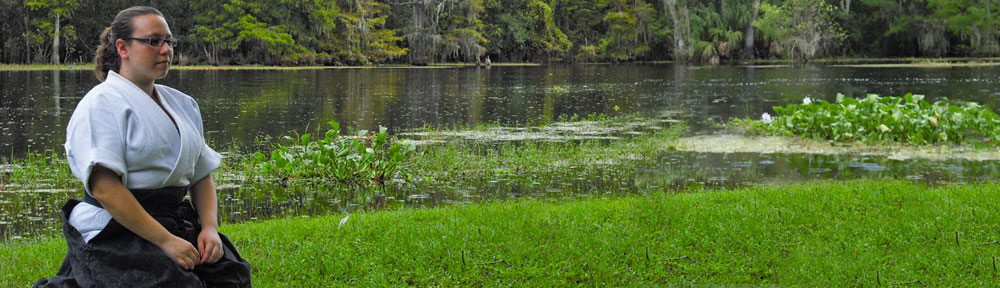
Wendy Whited Sensei will be teaching a three-day seminar hosted by the University of South Florida Aikido. Whited Sensei holds the rank of rokkudan (sixth degree black belt) and has been training in Aikido for nearly 34 years. She has trained at the Aikido Hombu dojo while living in Japan, and has rank in Judo, Karate and Iaido. She has also featured in the book “Women in the Martial Arts” by Carol Wiley (1992). She is the head instructor of the Inaka Aikido Dojo in Beecher, Illinois, affiliated with the Aikido Schools of Ueshiba. She is a student of Shihan Mitsugi Saotome.
Gallery: Kyu Testing 12-2007
Thoughts on being a Warrior
Being a Warrior is not a profession, or an act. It is a statement of identity, and a definition of spirit.
The vast majority of people who consider themselves Warriors simply are not, but the ones who are know it deep in their heart without doubt. It comes not from identifying yourself based on something you did, but on what you are becoming and absolute knowledge of what you will be – and what you will be is “something more”, always something more. Once you truly become a Warrior, you cannot unbecome one.
Warriors seek balance. Those who are unbalanced are not strong, and this always leads to a bad outcome. Balance means “in all things” – physical, emotional, spiritual, relationships, environment, careers, etc.
Warriors cultivate perspective. This means a view on the “big picture”, not just the pain of the moment. It may mean cultivating a little bit of dispassion or distance. It also means making one’s decisions based upon imagining looking back upon your life from your deathbed. Inevitably, perspective is sometimes lost, but Warriors relax in the certainty that they will find their perspective again soon and do not let themselves be captured mentally. This means also that Warriors let go of pain (anything negative) in order to focus on what they must do.
Warriors do not procrastinate. They know they may die tomorrow, and live their lives “with their affairs in order” and with nothing important undone. Warriors I know all hold a small wistful regret for wasted days; but they do not necessarily define “wasted” like non-Warriors. A day spent watching birds in the trees might have been a priceless day.
Warriors learn to recognize “the lazy voice” inside themselves which urges them to take it easy today. They feel really good when they ignore it. Warriors aren’t comfortable spectating for that reason, and look for opportunities to work on things on their own.
Warriors know the difference between being awake and being asleep.
Warriors are tenacious, determined. OK, face it, they’re stubborn. They don’t give up on a goal they set for themselves. When they aren’t naturally focused and determined for a task or goal, they break the task or goal into parts that are accomplishable. They don’t consider it a failure if they learn they must redefine their goals based upon experience. Warriors do not not attach themselves to any single outcome. Warriors are satisfied if their end-result doesn’t look like what they set out for, so long as it “meets the requirements”.
Warriors are insatiable, restless. Every day of their lives, they are pursuing new abilities, new skills, new attainment… even if nobody else can perceive or appreciate them.
True Warriors build things of beauty. They try not to break one thing of beauty in order to pursue another.
Warriors are unflinching self-critics, and accept criticism without anger or defensiveness. They examine their shortcomings mercilessly and constantly as if they stood outside themselves. However, this is merely a part of correct evaluation and goal-setting; they do not dwell on what they find and what do not punish themselves for their failures any more than they gloat over their successes. This is not because they are humble, just because they always know there is more they want to accomplish!
Warriors accept nothing without a critical eye, not compliments, not criticisms, not instruction. Warriors need proof. It is unfortunate when a Warrior cannot see Proof, however, so that perspective thing really is important, as are experimenting with countering ideas.
Warriors are not defined by age, gender, wealth, height, weight, ethnicity, nationality, likeability, or even martial ability.
Warriors value decisiveness. This is harder in practice than theory, but they know that the worst decision is no decision and trust in their ability to “course correct” toward a better outcome.
Warriors cherish surprises and beauty and new abilities and honesty and heartfelt friendship. Warriors cherish opportunities to “step up” when they are most needed. Warriors cherish challenges as opportunities to become more than they were the day before. Warriors seek fear and weakness inside themselves as something to be probed and understood.
Warriors aren’t concerned with names or labels, or for that matter, external opinions or rules or limitations. Warriors hear words like “you cannot” as “the average person cannot”.
Are you a Warrior? This is a rhetorical question, I’m not asking for a show of hands. Do you recognize these things in yourself? What are other characteristics of Warriors?
Feel free to substitute the term “Warrior” for “Artist”, “Craftsperson”, or whatever resonates in your heart.
Gallery: Aikido BBQ 4/2007
These photos were taken by Toivo Voll at our annual spring BBQ, which included an “aikilympics” competition.
Gallery: Kyu Testing 12/2006
Being Uke
2004 editorial by Guy Hagen
Ukemi – training as Uke, being the attacker, taking the falls — is probably the most important part of your Aikido experience. 99% of your interaction with your Sensei will be as an Uke. More importantly, Uke and Nage are two sides of the same coin. The way you train as Uke will shape the way you perform technique as Nage, and in the end how good of a martial artist you will become.
Unfortunately, students — and I mean our students too — fall into limiting, destructive patterns as Uke.
The best way to avoid these patterns is flexibility in our training styles. There is a saying in Tai Chi Chu’an: “train low center, train high center; train strong, train weak; train fast, train slow.” The message is that we must learn to “switch on” different ways of moving that best fit the situation and increase our understanding of the art.
Based on the different styles and Dojos that I’ve trained in and my own training and teaching, I’ve categorized a few important “ways of being Uke.” none of them is really better or “higher level” than the others, and I strongly urge every student to try each style with determination and sincerity. In my own training, I would often try to “be” each of these Ukes to the best of my ability for a couple weeks or a month at a time.
(1) Passive (Empty) Uke.
This Uke is essentially just “there” for their partner. No real resistance, no aggression, and they just let themselves be thrown. When working with new students that have enough difficulty getting their own hands and feet straightened out, it’s often best to “be” this type of Uke.
However, this doesn’t mean you get to sleep through the technique. Now is the chance for Uke to practice perfect posture and alignment, and deep, centered breathing without distraction. Don’t let your attention wander – you can still get hurt. I had my knee almost destroyed (literally) in Judo when I got confident and sloppy being a “passive uke” for a beginner student.
(2) Sincerity Uke.
This type of Uke also gets to focus on posture and clarity — and ferocity of attacks. A sincere Uke strikes or grabs with all their intent, focus and energy. This should be an intentional overcoming of laziness and fatigue (which we all experience). The attacks should never be sneaky, or have the hidden purpose of making you look good or your partner look bad.
A sincere attack prepares your partner for realistic situations. You may have to “tone down” the force of your attack to what your partner can handle; but too many “soft pitches” will give your partner a false sense of confidence and rob them of the growth that comes from being challenged.
After your sincere attack, continue your force and effort into the original direction of your attack (upon contact, press toward your partner’s center) until you are thrown or pinned. Sincere attacks are characteristic of all good Ukes.
Practice your punches! Practice ferocity! Don’t telegraph your attacks! Break up your timing!
(3) Acrobatic Uke
Believe it or not, it’s beneficial to exaggerate your attacks and falls sometimes. Attack fast, throwing all your center into your strike or grab. Abandon safety. When you are thrown or pinned, fling yourself as dramatically as you can ahead of the attack. Learn to feel what it’s like to accelerate out of your partner’s technique (by speeding up your center, not using force), and let your partner feel what it’s like to have done a technique masterfully.
This type of Uke will make you a popular training partner, and teach you to make big, pretty falls. If it’s all you ever do, however, you will never develop any real center, or learn how to “change your mind” mid-attack to protect yourself or change to a different attack. It definitely puts you at the mercy of your Nage, and if they step it up or act cruelly, you may suffer for it.
(4) Resistance (Static) Uke.
This type of Uke attacks with clarity and force, but actively resists when their partner begins a technique. This type of training builds strong centers, and reveals the flaws in your partner’s technique. For it to be honest, however, you must erase your memory before each technique, always attack honestly, and never begin countering a technique early just because you know it’s coming. This is important! It’s easy to block almost any technique if you know it’s coming, and the “You can’t throw me” game gets old really quickly. It also rapidly results in pointless struggling, no real learning, and crappy technique. If you and your partner begin “butting heads” this way, it just gets ugly and nothing more.
However, this type of Uke is also one of the more common and dangerous traps, to my observation. Many students somehow get the idea that being able to resist a senior partner’s technique demonstrates how good they are. Real resistance destroys any sensitivity and subtlety you may have, so you are unable to feel your partner’s technique — they may be trying to show you something, and you may be leaving them no resort but smack you on the head! Do this enough, and all your technique as Nage will look exactly like this – straining, forceful, ungraceful and violent, with a grimace on your face and every muscle in your body tense. Learn to recognize these symptoms in yourself before your growth becomes stunted. if your partner brings out these reactions in you, switch to being another type of Uke.
Too much of this is the antithesis of Aiki, and if I ever see a shodan test by someone in our Dojo where the candidate Nage looks like “resistance” Uke, I may cry.
(5) Reversal (Kaishi) Uke.
If you have become sensitive and skillful enough, you will begin to sense moments of weakness in your partner’s technique. If you can take advantage of that opening with a small, subtle and clean reversal, this is good training. Done correctly, this “kaishi” will flow naturally and spontaneously without force or struggle. It should never be situation where you overpower or yank away from your opponent’s technique — if both you and your partner can maintain this mindset, one reversal might simultaneously flow into another, and you both may experience continuation training, which I believe is one of the higher levels of training in Aikido.
(6) Guiding Uke.
Don feels there’s at least one more way to train as Uke, and after thought, I agree. Usually when our partner is having difficulty, we all like to give spoken advice – to teach (often after our “bad uke” caused the difficulty to begin with). Sometimes this is OK — but remember, this is Sensei’s class, not yours, and people generally want advice from you less often than you think. What you can try instead is to let your partner do the technique, while practicing the opposite of resistance. Without grabbing your partner or becoming Nage, shape and off-balance your body so that your partner performs the technique correctly. In a sense — Uke does the technique from start to finish, and Nage sort of “holds on.”
While reading this, you’ve probably told yourself several times “Oh, I already practice that way” or “yeah, I see other having problems with that.” Well, I think there’s only a handful of people in our Dojo who are truly proficient in ‘being’ all of these types of Ukes — and they are all yudansha. I personally look to improve myself in each of these, all the time… and maybe in a couple other ways too.
I believe that becoming the type of martial artist that people admire requires determination and discipline. It also requires constant self-examination and adjustment.
I’ve been told that students in our Dojo sometimes joke, “what kind of Uke is Guy going to be today? The sweetheart or the son-of-a-bitch?” Frankly, I take this as evidence my flexibility in training styles is clear enough that others can easily recognize it. Don’t be afraid to ask for feedback from your Nage — “Am I resisting too much? Was my attack good enough?” Remember, 50% of your training is as Uke, so you should be using that time to improve and practice every bit as much as when you are doing the technique!
Use your time as Uke to focus on the things that you aren’t able to focus on as Nage. Learn to switch from an invisible center to a powerhouse center as needed. Learn when to pour on your power, and learn when to be super-sensitive in your training. All these characteristics are important to being a well-rounded Aikidoka.
Gallery: Club Photo Archive (1975-2003)
Koichi Tohei Shihan Seminar at USF Aikido, 1965
Below features a clip (courtesy of AikidoJournal.com) of renowned Koichi Tohei Shihan teaching a seminar at the University of South Florida in 1965. Tohei Shihan was an uchi deshi (live-in apprentice/disciple) of the Founder, Morihei Ueshiba O-Sensei and himself the founder of the international Ki Society (Shin Shin Toitsu). You can clearly see the “USF” logo on the wrestling mat he is teaching upon. His primary uke is Yoshimitsu Yamada Shihan, the current head of the United States Aikido Federation.
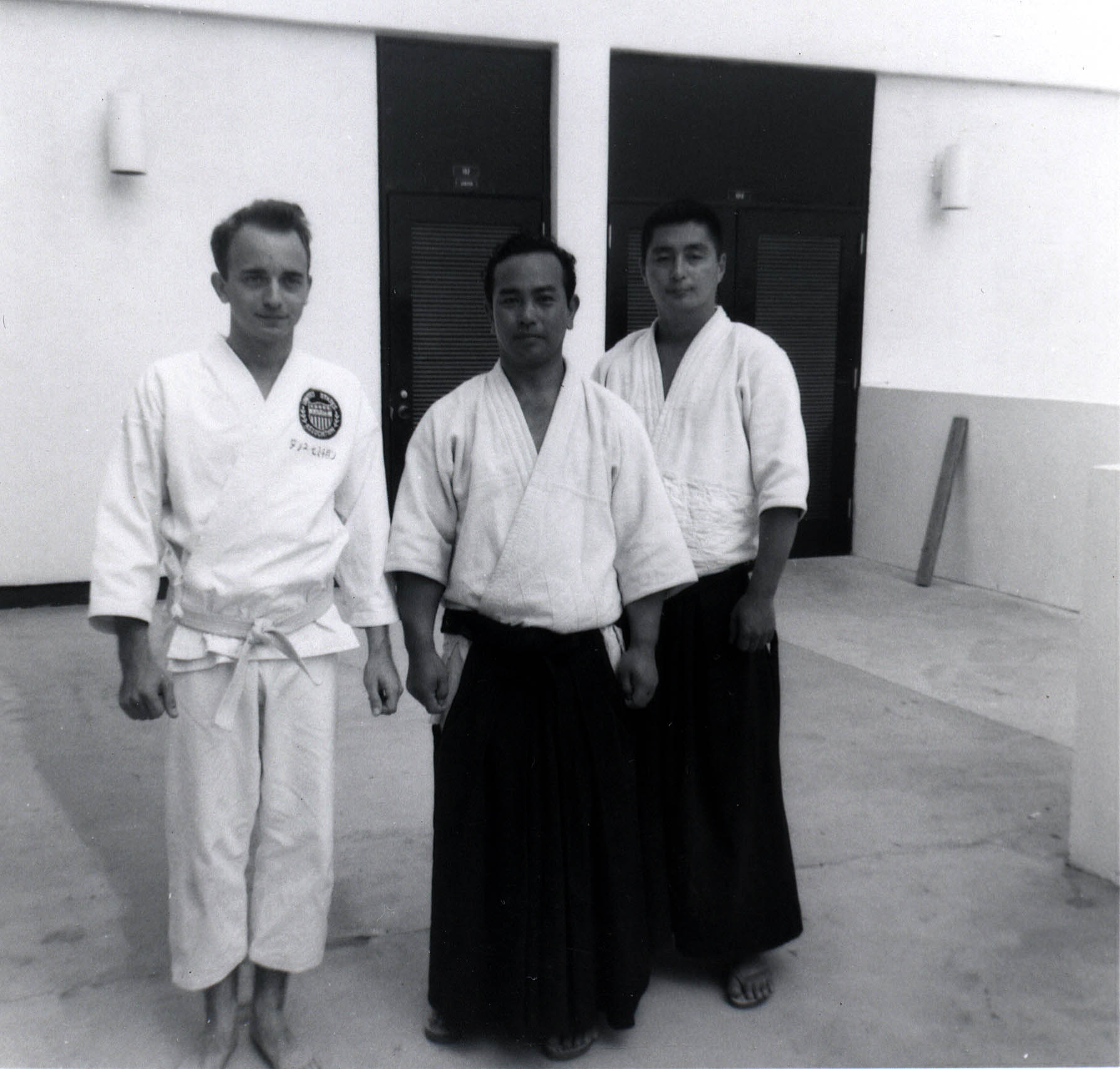
The following picture shows Tohei Shihan and Yamada Shihan posing together with one of our own instructors, a very young Daryl Schrader Sensei.
Tohei Shihan passed away in May, 2011.
